Community Services: How Does Corvallis Compare?

"Corvallis is a full-service city."
You might have heard that before, from your City Councilor or maybe at a public meeting. But what does it mean?
Core Services for Our Community
Corvallis directly provides nearly every municipal service—police, fire, ambulance, 911 dispatch, parks and recreation, library, streets, utilities, parking, city-owned transit, and many more.
Other cities in Oregon provide some combination of core services. In many comparable cities, some services are instead handled by other governments or partner agencies. Here are a few examples:
- In Beaverton, the city doesn't operate a Fire Department, because fire services are provided through Tualatin Valley Fire & Rescue, which serves 10+ member cities.
- Hillsboro doesn't have a wastewater treatment facility, because that utility infrastructure is provided by Clean Water Services, which serves many communities on the west side of the Portland metro area.
- In Bend, park maintenance and outdoor recreation is provided by the Bend Park and Recreation District. Those services aren't provided by the City of Bend.
Middle of the Pack
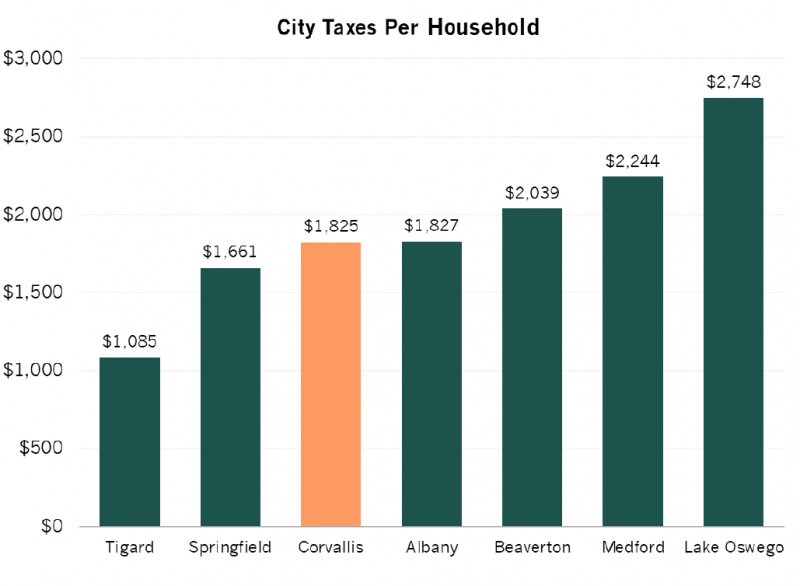
Corvallis does more with less - a lot more. We're a full-service city, but the amount of property tax that typical households pay for city services is right in the middle of comparator cities.
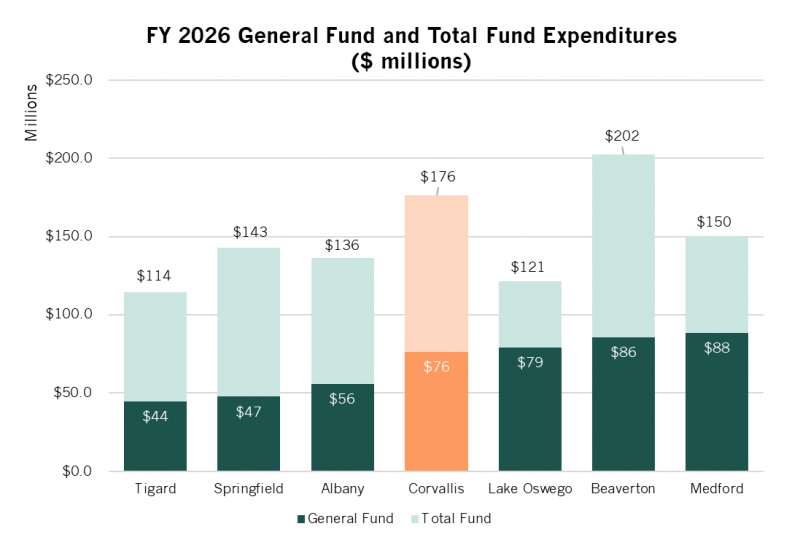
A closer look at the City or Corvallis general fund is similarly revealing.
The general fund is the most flexible pot of money for most cities. Even though we're providing more services than our comparator cities, we're doing it with a general fund balance that's roughly in line with our neighbors.
Corvallis Does It All
The quality of community services delivered by the City of Corvallis have consistently scored high ratings in our biennial community survey.
Providing more services directly gives taxpayers more local control and accountability—but it also means Corvallis carries costs that some other cities have shifted elsewhere.
Understanding how the City of Corvallis provides these services (many of which aren't provided by other cities in Oregon) is the starting point for how we're exploring solutions for the budget gap that is projected to arrive in 2027.


