Middle Housing Code Update Project
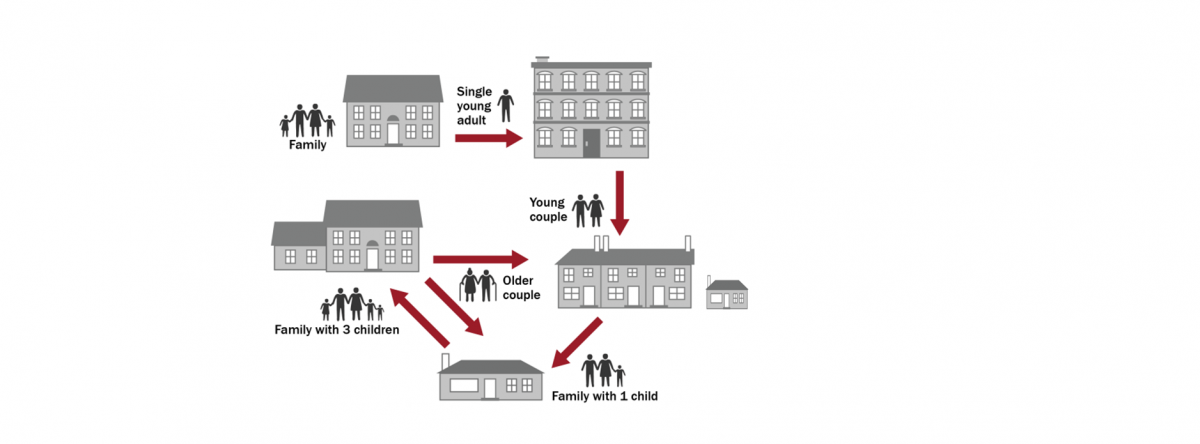
The Middle Housing Code Update Project Was Completed in 2022.Since 2022, additional changes in State law and local land use policy have resultedin additional code amendments related to Middle Housing.
Additional amendments are expected in 2026 and 2027 based on 2025 legislation.Current Middle Housing provisions are contained in the current Land Development Code.
General information about Middle Housing is provided below. |
What is Middle Housing?
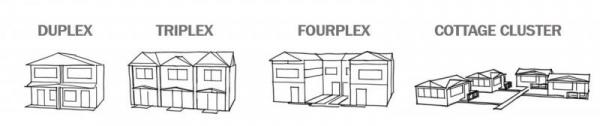
Middle Housing includes building types other than single family homes and apartments, such as duplexes, triplexes, fourplexes, and cottage clusters. Code updates that became effective in June of 2022 allow one or more of these middle housing types in residential zones throughout Corvallis. Currently, Middle Housing types will be limited in certain areas based on property configurations and lot sizes. However, Oregon legislation signed into law in 2025 will require additional Corvallis code amendments. These additional amendments are expected to be completed by the State mandated deadlines in 2026 and 2027.
What is the Zone of my property? Where can Middle Housing be built?
The code and map amendments, adopted in 2022, resulted in changes to the allowed uses and development standards of residentially-zoned property. Generally, these changes provide more flexibility to construct a variety of housing types throughout Corvallis.
If you would like to know what the zone of your property is and Middle Housing options in your neighborhood, this online mapping tool can provide that answer.
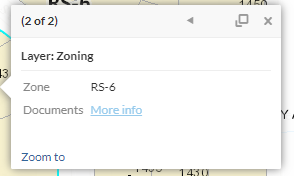
Enter a valid street address in the search box, and make sure the "Zoning" layer is turned on in the list of map Layers. Clicking on a location on the map, and then the "More Info" link in the Zoning layer will provide access to the Zone's Middle Housing allowances.
Additional Code Update Timeline and Project Information -
The Oregon legislation signed into law in 2025 will require additional Corvallis code amendments. These additional amendments are expected to be completed by the State mandated deadlines in 2026 and 2027.
In 2019, the Oregon legislature passed House Bill 2001, in an effort to address the State's housing deficit. The bill became law and amends Oregon Revised Statute 197, which requires cities (including Corvallis) to:
1. Allow duplexes on each lot or parcel zoned for residential use.
2. Allow other middle housing types (triplex, fourplex, cottage cluster and townhome) in areas zoned for residential use, that currently allow single family homes.
In late 2019 and 2020, the Oregon Department of Land Conservation and Development commenced a rule-making process to update related administrative rules, and to develop a model code and minimum compliance standards for the purposes of helping cities to implement changes to ORS 197. Additionally, the legislation included technical assistance funding, which led to a grant being awarded to the City of Corvallis. The grant provided consultant services (led by Angelo Planning Group) for this project. To meet the State's requirements, Corvallis updated its development code in June of 2022. The Oregon administrative rules and model code were used to provide guidance in updating the local development code.
The first phase of this project was completed in June of 2021. Completion of the first phase resulted in an adoption-ready draft of Comprehensive Plan and Land Development Code amendments, for purposes of implementing the middle housing requirements of ORS 197. The code amendments were developed with the assistance of Angelo Planning Group and the Middle Housing Departmental Advisory Committee, and also considered public comments received during the project's April 2021 online open house. You can view a summary of the Middle Housing Departmental Advisory Committee and project management team recommendations, as well as the consultant's review of current Land Development Code and its compliance with Middle Housing requirements here:
Middle Housing Project Summaries
The second phase involved work sessions with the City Council and Planning Commission, to review the recommendations of the advisory committee and discuss any remaining policy concerns. Following the work sessions, city staff prepared the final draft of the code amendments for the public hearing and adoption process.
The third and final phase involved the public hearings and adoption process.
- The first public hearing occurred February 2, 2022 (Planning Commission).
- Following the Planning Commission public hearing, revisions to the proposal occurred that resulted in a final recommendation from the Planning Commission.
- The Planning Commission's recommendation is presented in this April 18, 2022, City Council Packet - https://apps.corvallisoregon.gov/webdocs/showdoc.aspx?docID=2758640
- The City Council deliberated on May 16, 2022, and adopted Ordinance 2022-11, 2022-12, and 2022-13, implementing the code and map changes. Links to the Ordinances are available at the top and bottom of this page.
Middle Housing Departmental Advisory Committee (MHDAC)
Members of the Middle Housing Departmental Advisory Committee were chosen by the Community Development Director, to provide guidance to the Director and other City staff as key decision points for the project unfolded. MHDAC meetings occurred in 2020 and early 2021. The committee is no longer meeting. More information regarding the committee, its meetings, agendas, and packets are available here:
Will My Property or Neighborhood’s Private Agreements (Codes, Covenants, and Restrictions (CC&Rs)) Prevent Middle Housing?
2025 legislation made private covenants banning middle housing retroactively unenforceable. ORS 93.277 (as amended by the 2025 legislation) now reads as follows:
Oregon Revised Statute 93.277 [as amended by the 2025 legislation]
(1) A provision in a recorded instrument affecting real property is void and unenforceable, as being against the policy of this state of promoting housing availability and affordability and affirmatively furthering fair housing as defined in ORS 197A.100, if, within an urban growth boundary as defined in ORS 197.015, the provision would allow the development of a single-unit dwelling on the real property but would prohibit the development of, or the partitioning or subdividing of lands under ORS 92.031 for:
(a) Middle housing, as defined in ORS 197A.420; or
(b) An accessory dwelling unit allowed under ORS 197A.425.
(2) A provision in a recorded instrument affecting real property is not enforceable if the provision would allow the development of a single-unit dwelling on the real property but would prohibit the development of:
(a) A manufactured dwelling, as defined in ORS 446.003; or
(b) A prefabricated structure, as defined in ORS 197A.015.
(3) Subsection (2) of this section applies only to an instrument executed on or after January 1, 2026.
[as amended by the 2025 legislation – Section 8 of HB 2138 reads]:
ORS 93.277 applies to instruments executed before, on or after January 1, 2021.
CC&Rs are private agreements between land owners and they are enforced by them (or entities like Homeowners Associations). Corvallis and other cities do not enforce these private agreements and review of title is not part of the development process. CC&Rs and other deed restrictions are filed with the County Recorder’s office and can also be obtained through title companies.


